
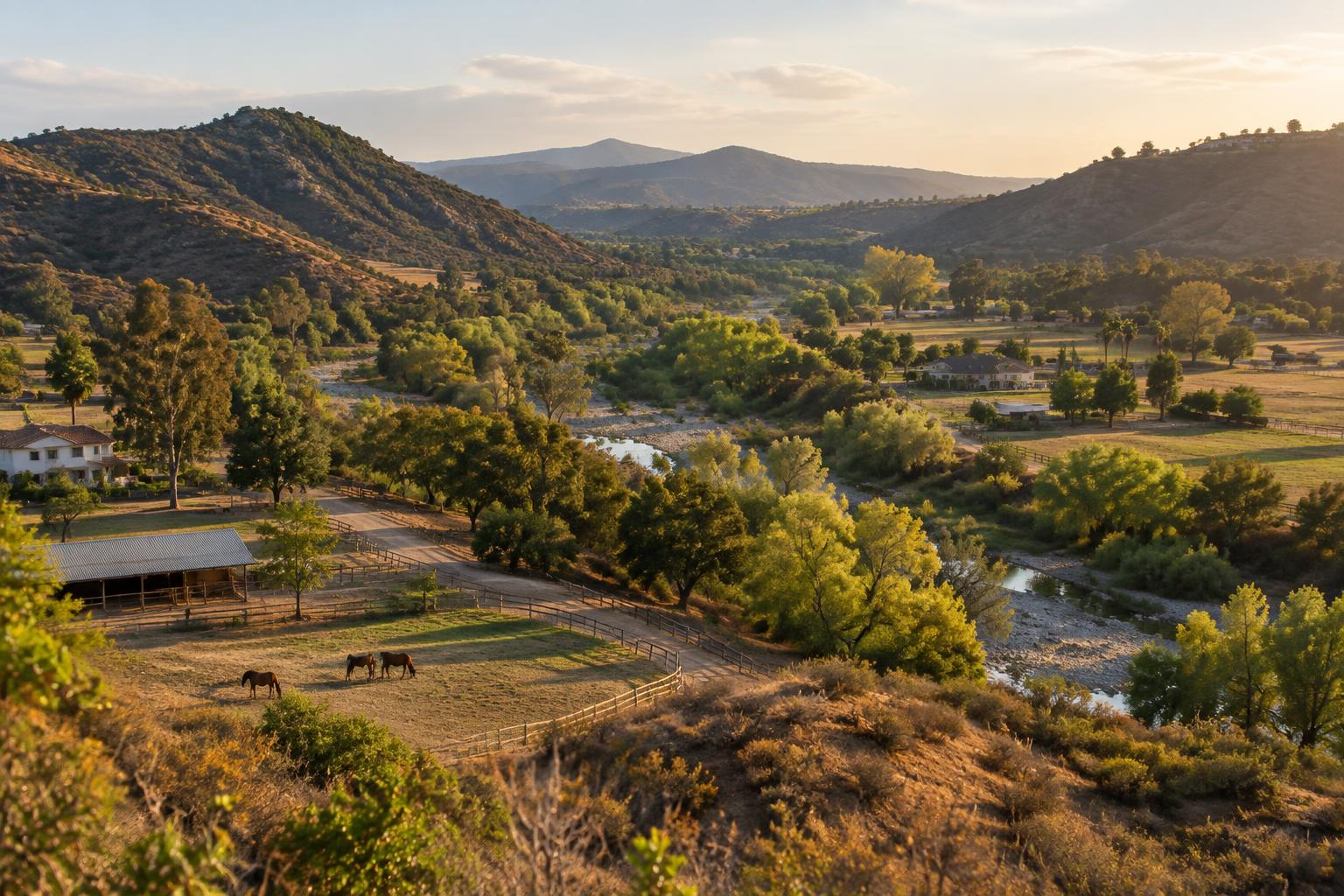
Boundaries before branding
The County Bonsall planning area borders Fallbrook, Oceanside, Valley Center, Vista, and the North County Metropolitan Subregion. Use its plan maps and the parcel record rather than a Bonsall or neighboring postal label. Land-use, school, and utility district boundaries are separate.
Areas to compare
Mission Road and Olive Hill Road node
Compare access to everyday services, road traffic, slope, and the specific housing product. A service cluster does not make all of Bonsall walkable.
Camino del Rey and former San Luis Rey Downs orientation
Compare attached or clustered housing with surrounding estate land. Verify association membership, permitted uses, utility connections, and whether any nearby equestrian facility is private.
San Luis Rey River corridor
Evaluate flood and drainage constraints, easements, legal entrances, and current trail openings. River proximity does not create unrestricted access or development rights.
Olive Hill and surrounding hill properties
Inspect gradients, usable pads, road agreements, irrigation demand, permitted outbuildings, and insurance before paying for gross acreage.
Buying in Bonsall
Start with usable land, river or slope constraints, legal access, and utility records. Confirm septic versus sewer and the permitted status of horse facilities or extra dwellings; a Bonsall label does not settle those conditions.
Build the monthly budget around the actual property. Include the loan, property taxes, insurance, maintenance, utilities, and every association or special assessment. Use the current tax bill to identify Mello-Roos or other special taxes rather than assuming that all homes in Bonsall have the same charges. Keep active asking prices separate from closed-sale evidence.
Rainbow Water serves Bonsall, but sewer service covers selected areas only. Investigate flood constraints near the river, septic capacity, road easements, irrigation demand, slopes, defensible space, and address-specific insurance.
For a condominium or townhome, read the association budget, reserve study, meeting minutes, insurance, repair plans, rules, and assessment history. Establish who maintains the roof, exterior, drainage, and common areas. For a detached home, inspect site drainage, retaining walls, roof condition, and repair records. Establish whether solar is owned, financed, leased, or under a power-purchase agreement and what transfers to you.
Start with the monthly buying budget, home-type comparison, and inspection and insurance guide. The buyer closing-costs article helps separate your down payment from the rest of the cash needed to close.
Selling in Bonsall
Use comparables with similar terrain, access, utility arrangements, and permitted improvements. Explain public versus private recreation and provide records supporting agricultural or equestrian claims.
Gather permits, final inspections, repair records, warranties, the tax bill, solar agreements, and association documents before launch. Describe the property accurately, including usable outdoor space, parking, access rights, and recurring costs. Do not advertise school enrollment, rental income, future construction, or an ADU as guaranteed.
Match the preparation plan to condition and comparable sales. A targeted repair or clear disclosure may be more appropriate than an expensive remodel. Review pricing your home, California seller disclosures, and what to fix before listing.
ADUs, land use, and income assumptions
For County parcels, check use regulations, setbacks, animal designators, access, utilities, and septic capacity. Acreage alone does not authorize an ADU, commercial horse boarding, or subdivision; verify each proposed use separately.
An existing extra dwelling needs permit and final-inspection verification. A large lot does not establish a legal second-home entitlement. Check setbacks, access, utilities, parking rules where applicable, easements, and any association restrictions with the agency responsible for the parcel. Obtain actual construction and financing estimates before treating projected rent as part of your buying budget. The San Diego ADU buying guide is a starting point, not a parcel approval.
Daily services and local routines
Mission Road/Olive Hill Road and SR-76 organize services and regional errands. Rural hill properties may require longer local drives than a map suggests. Compare the routes to groceries, feed or maintenance supplies if relevant, and school pickup from the actual address.
Practical tradeoffs
| Priority | What may work | What to verify |
|---|---|---|
| More land | Larger-property and outdoor-space choices | Usable area, zoning, slopes, and easements |
| Rural setting | Privacy and varied detached homes | Utilities, insurance, and road maintenance |
| Outdoor routine | Nearby public recreation | Legal entrances, closures, and the actual drive |
Property-tour checklist
- Confirm the parcel's jurisdiction and the neighborhood or planning boundary.
- Compare the same home type and micro-location using recent closed sales.
- Read the full tax bill, including special taxes and assessments.
- Identify every HOA and clarify maintenance and amenity rights.
- Obtain an address-specific insurance quote before committing.
- Inspect roof, drainage, retaining walls, foundation, and repair history.
- Verify permits and final inspections for additions, conversions, and extra units.
- Confirm utility connections, providers, and any private systems.
- Check easements, road maintenance, driveway access, and usable outdoor area.
- Test the actual commute and daily errand routes at your usual times.
- Verify school assignment and enrollment by address and grade.
- Review solar transfer terms and recurring maintenance costs.
- Revisit the street at a different time to check noise, parking, and activity.
Compare nearby communities
Compare the Fallbrook guide for village and grove-country alternatives. Compare the Vista guide for city housing and transit connections. Compare the Valley Center guide for other rural and planned-subdivision choices.
Official resources
Facts below were reviewed for this guide on November 12, 2026. Boundaries, programs, routes, and access can change; confirm the details relevant to your address.