
As of the latest county-wide data, 22.3% of active San Diego County listings carry a price reduction, yet the typical closed sale still lands at 99.2% of the original asking price. Those two numbers together tell you the real story: broad "the market has crashed, offer whatever you want" thinking is wrong, but a meaningful slice of listings genuinely have room to negotiate. The skill is telling which is which before you write an offer.
Why both numbers can be true at once
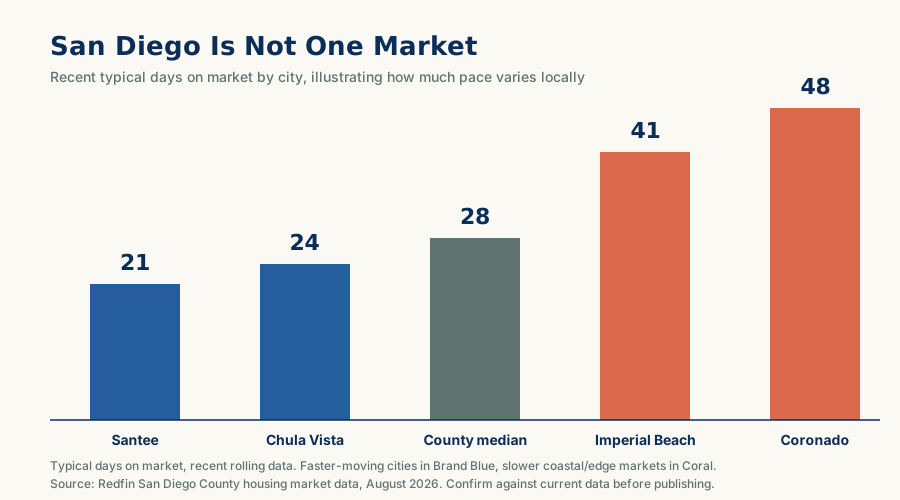
A home can carry a price reduction and still be competitively priced for what it is today. Reductions happen when an initial list price assumed comps or demand that did not materialize, when a seller needs to move on a timeline, or when a specific micro-market slowed for a few weeks even as the county overall stayed active. Meanwhile, a home that is priced right from day one in a tight pocket, Santee and Chula Vista were both moving in well under a month recently, can still draw multiple offers and close near or above list. Price reductions are a signal worth investigating, not a blanket discount code.
How to read a price reduction correctly
Check the reduction against the original list price and days on market together. A 2% trim after a week on the market usually means the initial price was just slightly optimistic. A 5%+ cut after 30-plus days is a stronger signal that either the price or the property has a real issue worth understanding.
Ask why, specifically. Your agent can usually find out whether the home has had showings with no offers (a pricing or condition problem), very few showings at all (a marketing or timing problem), or a specific issue that surfaced in early inspections.
Look at what similar homes on the same street or in the same complex have actually closed for, not just what is currently listed. List prices are opinions; closed prices are data.
What to actually offer
There is no universal formula, but a few starting points hold up in most San Diego negotiations right now:
On a home under 14 days on market with no reduction, price near or at list and move quickly if the home fits, since C.A.R.'s county figures put median days on market at 19 and Redfin's at 28, both faster than a buyer expecting a slow fall market might assume.
On a home 30-plus days on market with one price cut already, a modest offer under the current asking price, paired with a specific ask (repairs, credit, or a slightly longer close), is often more productive than a single aggressive lowball.
On a home that has had two or more reductions, dig into condition and comparable closed sales before assuming the price is now "right." Sometimes it still is not.
Price cut vs. seller credit vs. rate buydown
These are not interchangeable, and which one helps you more depends on your financing:
A lower price reduces the loan amount and, over the life of the mortgage, the total interest paid.
A seller credit toward closing costs frees up your own cash at closing but does not change your monthly payment.
A rate buydown, where the seller credit is applied to permanently or temporarily lower your interest rate, can meaningfully reduce your monthly payment, sometimes more than an equivalent price cut would, especially with rates in the high-6% to low-7% range. Ask your lender to run both a straight price reduction and a buydown against your specific loan so you are comparing actual payment numbers, not just which sounds bigger.
Frequently asked questions
Can you offer below asking price in San Diego right now?
On some homes, yes, particularly ones that have sat for several weeks with one or more price cuts already. On freshly listed, well-priced homes in high-demand pockets, the typical closed sale is still landing close to 99% of asking price, so a lowball offer there is more likely to lose the home than win a discount.
What should I offer on a home that has been listed for 30-plus days?
Start by finding out why it has sat: overpricing, condition issues, or a slow micro-market. A genuinely overpriced, well-located home with no major issues can support an offer meaningfully under list, while a home with real condition problems may be better approached with a credit request than a price cut alone.
Is a seller credit better than a lower price?
It depends on your financing. A seller credit toward closing costs or a rate buydown can lower your monthly payment more than an equivalent price reduction, especially in a higher-rate environment, because it can be applied directly to points. A straight price cut lowers what you finance and, long term, what you owe. Ask your lender to model both against your specific loan.
Does a price reduction always mean something is wrong with the home?
No. Reductions happen for all kinds of reasons, including an initial list price set too high relative to the specific block or comparable sales, a seller relocating on a deadline, or a slower few weeks for that micro-market. It is worth investigating, not assuming.
Next step
Want the current list of San Diego homes with recent price reductions in your target area and budget? Get your custom San Diego home search, and we will flag which ones look like real opportunities versus which ones still need a closer look.