
Central San Diego
Living in Mission Hills: San Diego's Most Architecturally Significant Historic Neighborhood
San Diego's most architecturally significant historic neighborhood: Craftsman and Spanish Colonial streets, canyon and bay views, and a genuinely walkable village core, minutes from Downtown.
The Vibe
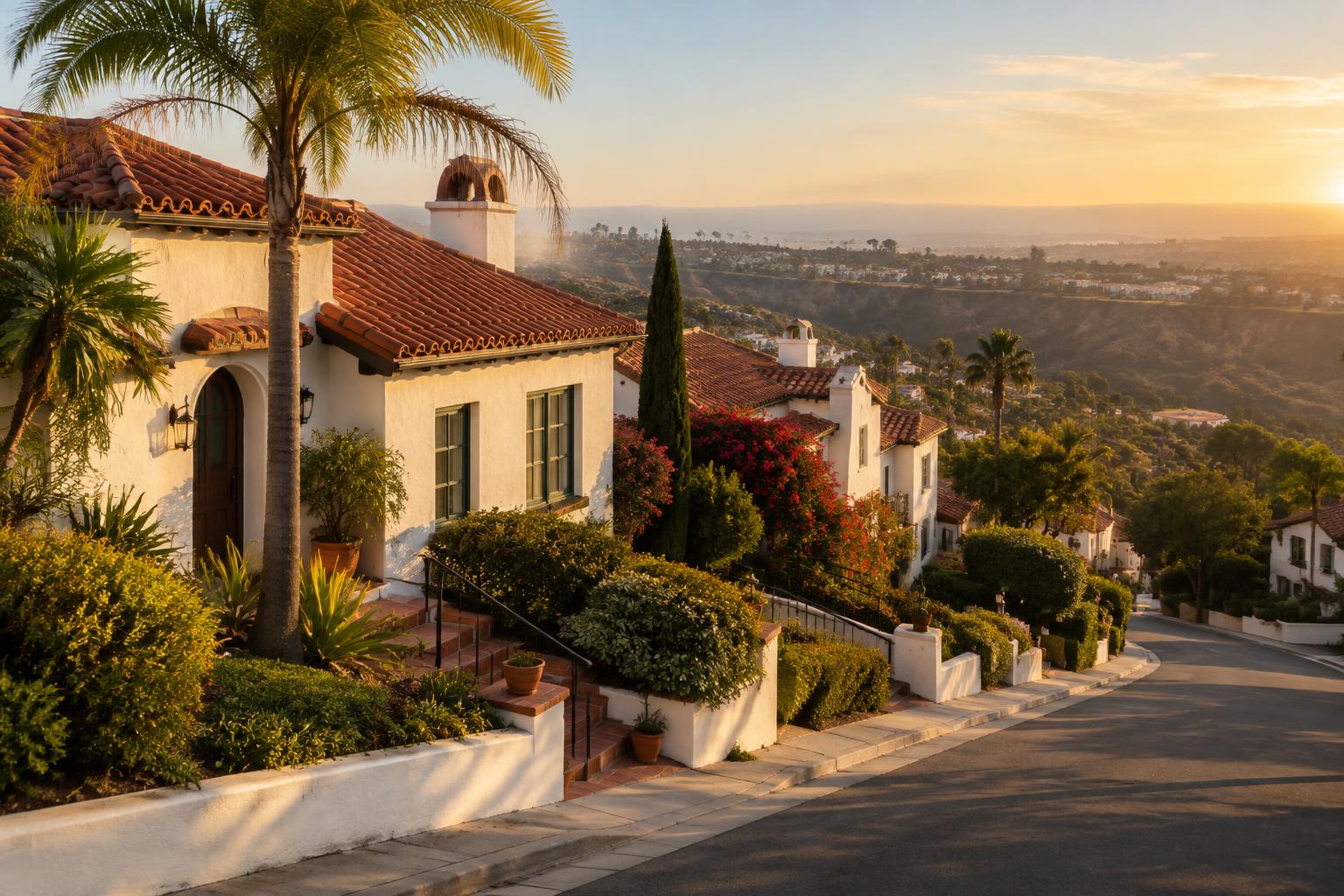
Mission Hills sits on the hills overlooking Old Town, Mission Valley, Downtown San Diego, and San Diego Bay, in the Uptown San Diego planning area within zip code 92103. A sea captain's family built the neighborhood's first home in 1887, and civic leader George Marston acquired 22 acres from horticulturist Kate Sessions in 1908, commissioning architect George S. Cook to design the subdivision that would become Mission Hills. More than a century later, it remains one of San Diego's most architecturally significant residential neighborhoods. It isn't one neighborhood; it's five distinct pockets, South Mission Hills, North Mission Hills, the Fort Stockton Corridor, West Lewis Village, and the Canyon Rim Homes, unified by tree-lined streets, walkability, and a century of continuous residential character.
Mission Hills appeals to buyers looking for a neighborhood with character rather than cookie-cutter development. Kate Sessions began buying land here in 1903 and spent the next 24 years living and working in the neighborhood; she was instrumental in bringing the trolley line down Fort Stockton Drive, and founded the Mission Hills Nursery in 1910, still an active business today. That layered history shows up on nearly every block: Craftsman bungalows and Spanish Colonial Revival estates sit alongside mid-century canyon-rim homes, and many properties retain original architectural details increasingly rare in Southern California.
Unlike neighborhoods built around a single downtown, Mission Hills' social life happens across several distinct gathering places. Fort Stockton Drive, the community's signature street, is lined with independent restaurants, wine bars, coffee shops, and boutiques, one of San Diego's most enjoyable walkable commercial districts. West Lewis Street offers a quieter, more traditional neighborhood main street feel, with cafes and specialty markets rather than a shopping-center atmosphere. Pioneer Park, a six-acre former cemetery converted to parkland in 1970, and Presidio Park, roughly 40 acres marking the 1769 site of the first European settlements on the West Coast, round out the neighborhood's outdoor gathering places.
Mission Hills has an A- grade for school quality, offering solid academics in a central historic neighborhood. It has a Walk Score of 70, and consistently strong long-term appreciation.
Live here if…
- Historic architecture and character matter more to you than new construction: Craftsman homes, Spanish Colonial Revival estates, and mid-century canyon-rim residences define Mission Hills' streets, many built between 1908 and the 1940s
- You want genuine walkability in a historic setting: Mission Hills carries a Walk Score of 70, the 34th most walkable neighborhood in San Diego, with Fort Stockton Drive and West Lewis Street both fully walkable village cores
- A central location matters to you: Mission Hills sits minutes from Downtown, Little Italy, Balboa Park, and the airport
- You want a genuinely independent, chef-driven dining scene rather than national chains: Fort Stockton Drive and West Lewis Village are anchored almost entirely by locally owned restaurants and cafes
- You want real canyon or bay views without leaving a walkable neighborhood: South Mission Hills and the Canyon Rim Homes both offer genuine elevated views toward Downtown, San Diego Bay, and Old Town
- You want a real track record of long-term appreciation in an established community: Mission Hills has been one of San Diego's most desirable addresses for more than a century
Maybe not if…
- You want a single, uncomplicated median home price figure: Mission Hills' real estate data diverges sharply by source and period, from $1.54 million to $2 million depending on the reporting window and boundary used
- You want brand-new construction: because most of Mission Hills was built between 1908 and the 1940s, with a second wave of canyon-rim homes in the 1950s-60s, genuinely new construction is rare here
- You need move-in-ready inventory on a short timeline: limited inventory and historic-designation or preservation guidelines on some properties mean desirable homes often sell quickly and older systems may need updating
- You want the most affordable entry point in central San Diego: Mission Hills carries a genuine price premium tied to its historic character and central location
- You want a single dominant commercial hub: Mission Hills' commercial life is split across two distinct corridors, Fort Stockton Drive and West Lewis Street, rather than one central downtown
Neighborhood DNA
How Mission Hills scores across the lifestyle factors that actually shape day-to-day life.
Family Friendly is a strong aspect, with North Mission Hills in particular repeatedly cited as a family-oriented area, though the neighborhood's identity skews somewhat more toward professionals, empty nesters, and luxury buyers overall.
Mission Hills has a strong school quality. Grant K-8 (1425 Washington Plz, 7/10 GreatSchools, A- Niche) is the school most directly located within Mission Hills. Other schools commonly associated with the area include Florence Elementary, Roosevelt International Middle, San Diego High School (International Studies), and Point Loma High School.
A genuine Walk Score of 70, ranked 34th most walkable in San Diego, with the Fort Stockton Corridor and West Lewis Village both fully walkable village pockets.
Fort Stockton Drive and West Lewis Village together anchor a strong, almost entirely independent dining scene, though 2 of the 11 originally named local favorites have closed.
Kettle & Stone and Gelato Vero Caffe both anchor a genuine, independent coffee and cafe culture, with Meshuggah Shack's Mission Hills location adding a third option.
Pioneer Park, Presidio Park, and Maple Canyon's roughly 25-acre trail give Mission Hills a genuinely strong outdoor profile for a dense, historic, largely built-out neighborhood.
Wine bars and pubs along Fort Stockton Drive (Wolf in the Woods) and nearby India Street (Shakespeare Pub) support a genuine, if low-key, evening scene rather than a dedicated nightlife district.
A century of continuous residential identity, active historic preservation advocacy (Mission Hills Heritage), and Pioneer Park's community events all support a genuine sense of place.
South Mission Hills' historic estates and the Canyon Rim Homes' view properties anchor a genuine luxury tier, among the strongest in central San Diego neighborhoods.
Mission Hills' median price runs well above the San Diego citywide median, about $1.54 million to $2 million, reflecting its historic character and central location rather than genuine affordability.
More than a century of sustained desirability and consistently limited inventory have historically supported strong long-term appreciation.
The Fort Stockton Corridor's walkability appeals genuinely to young professionals, though Mission Hills' overall identity and price point skew somewhat older and more established.
West Lewis Village's quieter, walkable, everyday convenience character and its appeal to empty nesters both support genuine retiree appeal.
Pioneer Park's open green space is genuinely popular for dog walking, and Presidio Park and Maple Canyon both add further trail-based pet-friendly options.
Pioneer Park (about 6 acres), Presidio Park (about 40 acres), and Maple Canyon (about 25 acres, shared with Bankers Hill and Little Italy) give Mission Hills a genuinely useful park system for a dense, historic, largely built-out neighborhood.
Fort Stockton Drive's boutiques and West Lewis Street's specialty markets give Mission Hills a genuine, if small-scale, walkable retail identity distinct from a shopping-center model.
Genuinely minutes from Downtown, Little Italy, Balboa Park, and the airport.
Mission Hills has no beach or bay frontage of its own; the coast is a genuine drive away in any direction.
George Marston's 1908 subdivision, Kate Sessions' Mission Hills Nursery (still operating since 1910), and homes predominantly built between 1908 and the 1940s give Mission Hills the strongest, most continuously documented historic character.
Genuinely rare; Mission Hills' housing stock is overwhelmingly historic or mid-century, with limited land available for new construction in an already dense, built-out neighborhood.
Craftsman, Spanish Colonial Revival, and mid-century canyon-rim architecture together give Mission Hills an unmatched architectural diversity, with no two streets feeling exactly alike.
The specific combination of century-old historic character, genuine walkability, and elevated Downtown, bay, and canyon views isn't replicated elsewhere, though Bankers Hill and Kensington share real similarities.
Privacy varies sharply by area: the Canyon Rim Homes and South Mission Hills' larger estates offer genuine privacy, while the Fort Stockton Corridor's commercial density offers considerably less.
The Market
Price range
Trend
Median sale prices range from $1.54 million to $2 million. Mission Hills' values are heavily tied to micro-location; a house on a canyon rim or elevated ridge can trade very differently from a similar house a few blocks away with no view.
Luxury segment
- • Historic Spanish Colonial Revival estates in South Mission Hills
- • Mid-century canyon-rim view homes
HOAs & lots
Uncommon across most of Mission Hills' single-family historic housing stock; more common among condominium buildings near the Fort Stockton Corridor.
Home Styles
Mission Hills features some of San Diego's most desirable historic housing stock. Buyers will find Craftsman homes, Spanish Colonial Revival architecture, mid-century residences, luxury remodels, contemporary custom homes, canyon-view properties, condominiums, and historic estates. One of the neighborhood's greatest strengths is its architectural diversity: no two streets feel exactly alike, and many homes retain original details that are increasingly rare in Southern California.
Schools
Local Favorites
coffee
A neighborhood coffee shop and apothecary at 1619 W Lewis St in West Lewis Village.
A gathering place on India St for more than 30 years, known for authentic gelato, espresso, and pastries.
At 4048 Goldfinch St; a separate East Village location (1188 Market St) has closed, leaving this the group's sole remaining location.
eats
A New American restaurant at 1011 Fort Stockton Dr, opened in 2019 and recognized with a MICHELIN Plate in 2021.
A farm-to-table restaurant at 860 W Washington St, owned by Alberto Morreale, who also co-owns the small Fig Tree Cafe group (Hillcrest, Liberty Station).
An Italian restaurant and bistro at 741 W Washington St.
A deep-dish pizza and Italian beef spot at 4030 Goldfinch St; part of a small 2-location group with the original location in North Park, established 2005.
A wine bar and European-influenced bistro at 1920 Fort Stockton Dr.
A British pub established in 1990 at 3701 India St, currently open. At least one source places this address in neighboring Middletown rather than Mission Hills proper.
shopping
Mission Hills' signature walkable commercial street, lined with independent restaurants, wine bars, coffee shops, and boutiques.
A smaller, traditional neighborhood-main-street commercial district with cafes, specialty markets, and boutique retail.
parks
Also known as Mission Hills Park, a roughly six-acre former cemetery (Calvary Cemetery, established 1876, holding the remains of approximately 4,000 early San Diego settlers) converted to open parkland in 1970.
Roughly 40 acres on the neighborhood's western edge, marking the 1769 site of the San Diego Presidio and Mission, the first European settlements on the West Coast, with hiking trails and views of the city and San Diego River valley.
A roughly 25-acre canyon trail near the Little Italy/Mission Hills junction, featuring the historic 1905 Quince Street trestle footbridge; shared with neighboring Bankers Hill.
hidden gems
Founded by Kate Sessions in 1910, still an active business today, one of the neighborhood's most historically continuous local institutions.
Saturday in Mission Hills
Weekdays start with coffee on Fort Stockton Drive, a commute of just minutes to Downtown, Little Italy, or UC San Diego Health, then an evening walk beneath mature trees before dinner at a neighborhood restaurant. Weekends might mean browsing local boutiques, a picnic at Pioneer Park, exploring Presidio Park's trails and historic landmarks, a visit to Balboa Park's museums, or brunch with friends before walking home through one of San Diego's most beautiful historic neighborhoods.
Community Events
Getting around
Walkability: Walk Score of 70, ranked 34th most walkable neighborhood in San Diego, with the Fort Stockton Corridor and West Lewis Village standing out as fully walkable village pockets.
Biking: Genuine cycling access to Downtown and Little Italy, though the neighborhood does not have many dedicated bike lanes of its own.
Transit: MTS bus routes along Fort Stockton Drive, Washington Street, and India Street · No direct trolley station within Mission Hills itself
Drive times
- downtown
- 8 min
- utc
- 15 min
- little italy
- 6 min
- balboa park
- 8 min
- airport
- 10 min
Frequently Asked
Is Mission Hills a good place to live?
Yes, genuinely so, particularly for buyers prioritizing historic architecture, real walkability, and a central location minutes from Downtown, Little Italy, and Balboa Park.
What are the different areas within Mission Hills?
Five commonly recognized areas: South Mission Hills, North Mission Hills, the Fort Stockton Corridor, West Lewis Village, and the Canyon Rim Homes.
How old are the homes in Mission Hills?
Most were built between 1908 and the 1940s, with the neighborhood's first home dating to 1887; a second wave of canyon-rim homes was built during the 1950s and 1960s.
Who developed Mission Hills?
George Marston, a civic leader and park advocate, acquired 22 acres from horticulturist Kate Sessions in 1908 and commissioned architect George S. Cook to design the subdivision. Kate Sessions herself lived and worked in the neighborhood from 1903 to 1927 and founded the Mission Hills Nursery in 1910, which is still active.
What schools does Mission Hills feed into?
Grant K-8 School (1425 Washington Plz, 7/10 GreatSchools) is the school most directly located within Mission Hills. Other schools commonly associated with the area include Florence Elementary, Roosevelt International Middle, San Diego High School (International Studies), and Point Loma High School.
How much do homes cost in Mission Hills?
Figures diverge by source: $1.9 million (Redfin neighborhood page, November 2025, up 15.2 percent year over year), $1.54 million (92103 zip code, March 2026), and $2 million (a separate 12-month trailing figure, up 6 percent).
Is Mission Hills walkable?
Yes, genuinely so. Mission Hills carries a Walk Score of 70, ranked 34th most walkable neighborhood in San Diego, with Fort Stockton Drive and West Lewis Street both fully walkable village pockets.
How far is Mission Hills from downtown San Diego?
About 8 minutes by car in normal traffic, consistent with the neighborhood's genuinely central location.
What is Mission Hills known for?
Historic Craftsman and Spanish Colonial Revival architecture, tree-lined streets, Fort Stockton Drive's walkable restaurant scene, Pioneer Park, canyon and bay views, and a genuinely independent dining and boutique scene.
Does Mission Hills have beach access?
No. Mission Hills has no beach or bay frontage of its own; its appeal rests on elevated Downtown, canyon, and bay views rather than coastal proximity.
What are the Canyon Rim Homes?
Mid-century homes built primarily during the 1950s and 1960s along Mission Hills' canyon rims, offering dramatic canyon views, exceptional privacy, and panoramic patio decks, all within walking distance of local restaurants and shops.
Does Mission Hills have its own restaurant scene?
One of the most consistently independent dining scenes. Of the 11 restaurants originally named as Mission Hills local favorites, 2 (Harley Gray Kitchen & Bar and The Patio on Goldfinch) have closed, and the remaining 9 are open, with no true national or regional chain among them.
What happened to Harley Gray Kitchen & Bar and The Patio on Goldfinch?
Harley Gray Kitchen & Bar closed on December 19, 2025 after 12 years; a new concept from the owners of La Puerta is expected to open in the same space. The Patio on Goldfinch is also closed as of an April 2026 Yelp update.
How does Mission Hills compare to Bankers Hill, South Park, Kensington, and Point Loma?
Bankers Hill is denser and more condo-heavy with direct Balboa Park access; Mission Hills is quieter with larger historic homes. South Park has a younger, more eclectic feel; Mission Hills is more established and architecturally significant. Kensington has a smaller village core; Mission Hills is more central with greater architectural variety. Point Loma is coastal and marina-oriented; Mission Hills prioritizes walkability and historic character with canyon and bay views instead.
Is Mission Hills good for families?
Yes, particularly North Mission Hills, known for its larger lots, mature trees, and quieter residential streets. Mission Hills' overall identity also skews toward professionals, empty nesters, and luxury buyers.
How long do Mission Hills homes take to sell?
Often a while. This guide shows about 64 days on market, so buyers may have room to negotiate. Email, call, or DM me on Instagram and I'll pull the latest numbers for your street.
Why do Mission Hills prices vary so much?
Sources range from about $1.54 million to $2 million. Canyon-rim views and historic homes push prices up, so compare homes on similar streets.
What should Mission Hills sellers focus on?
Price against your exact street and views. Buyers here are patient and will compare closely. Email, call, or DM me on Instagram and I'll pull the latest numbers for your street.
Compare nearby
Both offer historic architecture and central locations. Bankers Hill has a denser urban feel with more condominiums and direct access to Balboa Park, while Mission Hills is quieter, more residential, and known for larger historic homes.
South Park has a younger, arts-focused atmosphere with a more eclectic business district. Mission Hills is generally more established, more affluent, and features larger homes with greater architectural significance.
Kensington offers a well-kept village atmosphere with a smaller commercial core. Mission Hills provides a more central location, greater variety of historic architecture, and easier access to Downtown and the airport.
Point Loma is more coastal and marina-oriented. Mission Hills appeals to buyers who prioritize walkability, historic homes, and a central location while still enjoying canyon and bay views.
From the SD Love Blog
Explore other communities
Thinking about Mission Hills?
Mission Hills rewards buyers who want genuine architectural character and central-city convenience in the same neighborhood. South Mission Hills' historic estates, North Mission Hills' larger residential lots, the Fort Stockton Corridor's walkable restaurant scene, West Lewis Village's neighborhood-main-street feel, and the Canyon Rim Homes' dramatic privacy and views are five genuinely different ways to live in one of San Diego's most architecturally significant communities. Reach out anytime, and I'll help you figure out which part of Mission Hills actually fits how you want to live.
Or contact Celeste directly