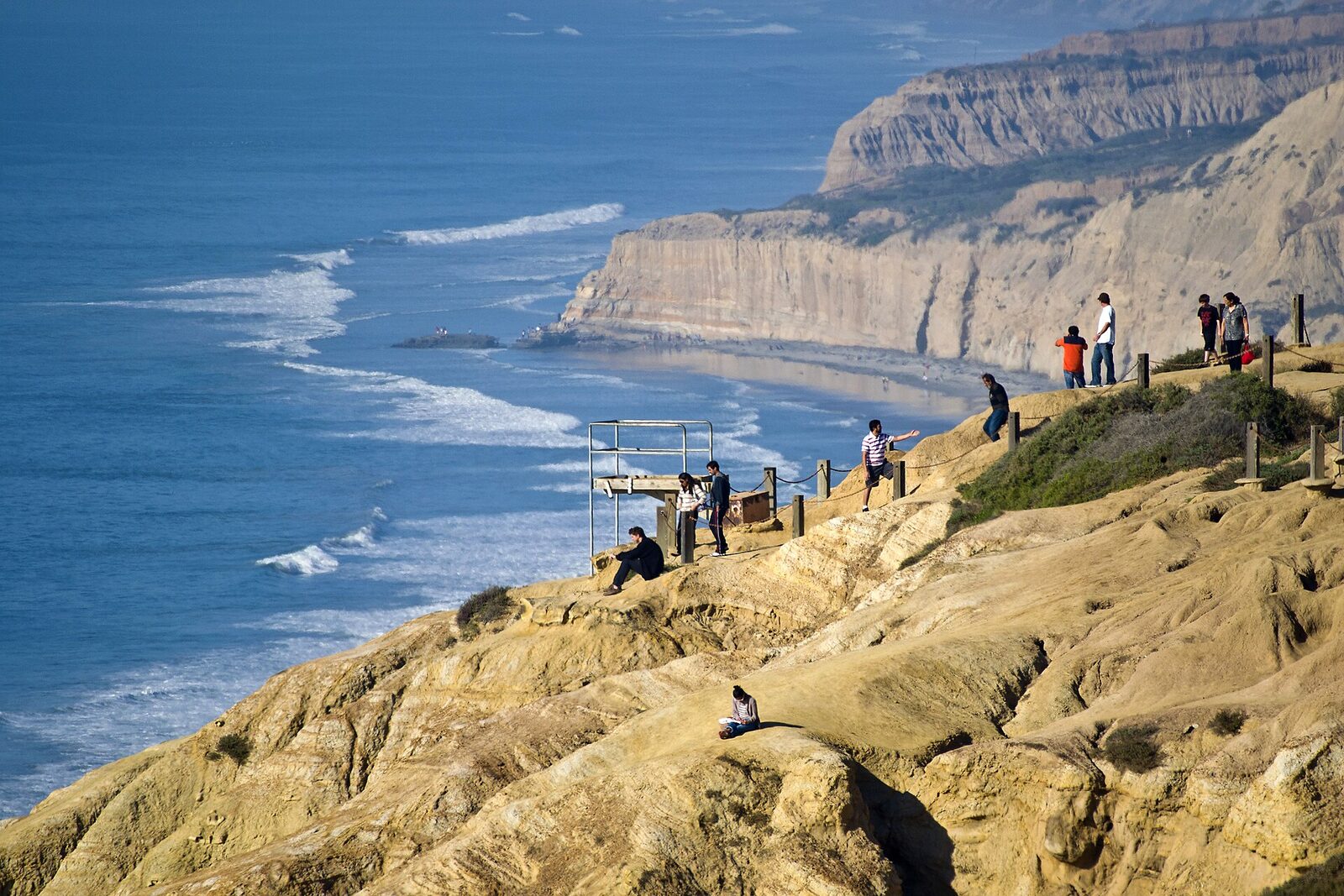
Strong schools and abundant nature, tempered by car dependence and, in the coastal corridor, steep bluff terrain.
Torrey Pines High School and Canyon Crest Academy both rate 10/10 on GreatSchools; Del Mar Heights and Del Mar Hills Elementary both rate 9/10; Torrey Hills Elementary rates 8/10.
Community-wide Walk Score of 64 (43rd most walkable in San Diego) masks a car-dependent reality within Torrey Pines' own boundaries; it is 'somewhat walkable in pockets, but fundamentally a car-oriented coastal suburb'.
Dining options are limited within the community itself, essentially confined to The Lodge at Torrey Pines' two restaurants; residents draw on Del Mar, Carmel Valley, and La Jolla for the bulk of their dining.
Torrey Pines State Natural Reserve, Torrey Pines State Beach, a two-course municipal championship golf facility, and the historic Gliderport paragliding site all sit within the community, an unusually dense concentration of protected natural and recreational assets.
No nightlife district exists within the community; it is explicitly a quiet, residential, early-to-bed lifestyle.
Dispersed and car-dependent rather than a walkable village; family- and nature-oriented rather than socially dense.
Custom homes, large lots, and privacy in the coastal corridor, plus the AAA Five Diamond Lodge at Torrey Pines, place this firmly in San Diego's upper luxury tier.
A high-cost, supply-constrained coastal market, consistent with the area's protected-land scarcity profile.
Bounded by ocean, protected reserve land, and freeways, with essentially no large-scale new home construction; the resulting land scarcity is a genuine long-term fundamental, not just a sales pitch.
A genuine commute advantage for biotech, UCSD, and Sorrento Valley professionals, offset by the car-dependent, nightlife-light lifestyle that is less suited to buyers who want a social, walkable evening scene.
Quiet, golf-oriented, and coastal, though buyers should weigh the area's car dependence against a more walkable retirement setting.
Torrey Hills Park's dedicated off-leash dog area is a genuine amenity, but Torrey Pines State Natural Reserve, the community's single largest open-space asset, prohibits dogs entirely, even inside a parked vehicle, a meaningful tradeoff for dog-owning buyers.
Torrey Pines State Natural Reserve, Torrey Pines State Beach, and Torrey Hills Park together give the community an unusually strong open-space footprint for its size.
Retail is essentially nonexistent within the community itself; residents rely on Carmel Valley, Del Mar Highlands, UTC, and La Jolla.
Strong for biotech/UCSD/Sorrento Valley commutes and coastal North County access via I-5, SR-56, and Del Mar Heights Road, offset by a genuine I-5 traffic tradeoff at peak hours and during events like Del Mar race season.
Exceptional geographically via Torrey Pines State Beach, but proximity to the ocean does not equal a walkable route to the sand for most homes.
The Torrey pine's status as one of the rarest pine species in the country, the golf course's 1957 opening and two U.S. Opens, and the Gliderport's aviation history dating to 1930 give the community a genuine, if non-architectural, historic identity.
Supply is genuinely limited; protected open space and built-out residential pockets mean new supply is mostly custom rebuilds and renovations rather than new subdivisions.
A genuine mix of custom luxury estates, substantially renovated mid-century homes, and more conventional suburban product in Torrey Hills.
The combination of a critically endangered pine species' primary wild habitat, a U.S. Open-caliber public golf course, a nearly century-old gliderport, and a major biotech employment corridor within one 2,600-acre community is not replicated anywhere else in San Diego.
Large lots, canyon and bluff adjacency, and protected open space border much of the coastal corridor; privacy is one of the area's defining values.